Tile underlayment near its end
Tile roofs past about 20 years in Valley heat often need new underlayment. That means lifting every tile, which can't happen while racking is anchored through them.
Roof Repair
Tile Roofing
Flat & Foam Roofing
Shingle & Metal Roofing
Replacement & Inspections
Solar, Vents & Extras
Phoenix neighborhoods
Valley cities
Counties
Solar, Vents & Extras
Your roof needs work, but there's a solar array bolted on top of it. We take the panels down, protect them on site, fix or replace the roof underneath, then reset the racking on freshly flashed mounts so the system goes back to producing.
Short answer
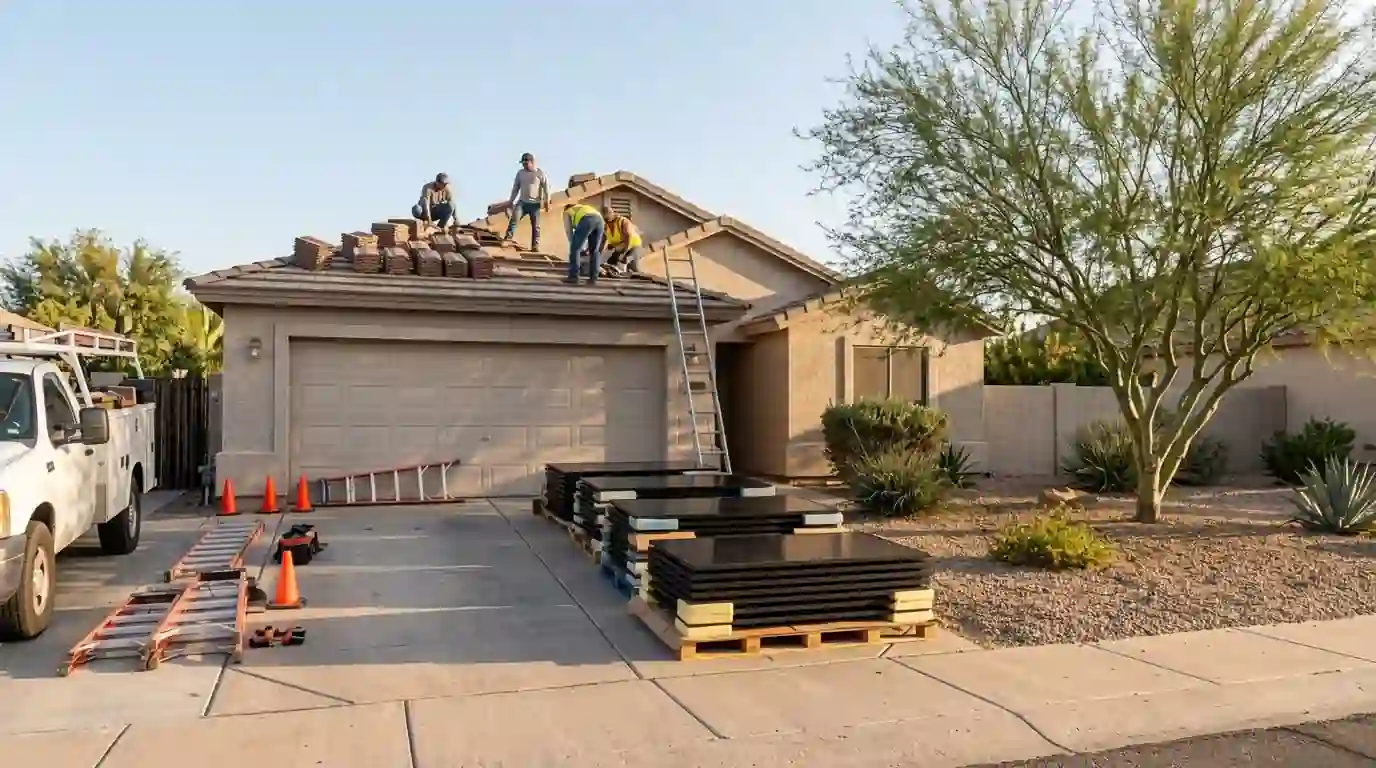
If a Phoenix roof needs a repair or replacement under solar panels, the array has to come off first. We shut the system down, number and remove the panels, stage them safely on site, finish the roof work, then reinstall the racking on new flashing at each mount. Most home detach and reset jobs add two to four working days around the roofing itself, depending on system size and roof type.
Materials we install and repair across the Valley
Before anything is unplugged, we ask for the system details: who installed it, whether it's owned, leased or financed, and who monitors it. Leased and financed systems often carry terms about who may touch the equipment, so we check those with you first rather than discovering them halfway through a tear-off. When the paperwork says the solar company must handle the electrical disconnect, we schedule around their visit. When it doesn't, our roofers shut the system down in the correct sequence and sketch the panel layout before a single module moves.
Monitoring is the part homeowners tend to forget. Once the array goes dark, the monitoring app will flag a production drop, and some providers open a service ticket automatically. We give you the shutdown date so the alert doesn't catch you off guard, and after reinstall we confirm with you that the system is reporting again. If the inverter or gateway shows a fault after reset, we sort out whether it's a connection on the roof or a component issue the solar company needs to look at.
Skylight work uses units from makers such as Velux, and the flashing and sealants we use around panels, vents and patio covers come from Henry and Tremco roof lines.
A home array can sit on anywhere from two dozen to more than fifty attachment points, and each one drives a lag bolt through the roof deck. On shingle roofs we install new flashed mounts with a metal base that slides under the course above. On tile roofs we use tile hooks or replacement flashing tiles, and we cut or swap tiles so nothing rests on a cracked edge. On foam and other low-slope roofs, mounts get a proper flashing detail tied into the coating, not a blob of sealant.
The older way of setting mounts on many Valley homes leaned heavily on caulk. Sealant cooks in Phoenix sun, where roof surfaces run 150 F to 170 F in July, and it shrinks away from the bolt within a few summers. When we reset an array, we don't reuse tired sealant details. Each penetration gets flashing that sheds water by overlap, with sealant only as a backup, and we check that every bolt lands in a rafter or solid blocking. On tile roofs nearing 20 years, we usually pair the reset with new underlayment beneath the tile so the roof and the array start over together.
Panels come down in rows and get numbered against the layout sketch, so each string goes back where it came from. We stack them on padded supports in a shaded part of the yard or driveway, glass up, away from where tear-off debris falls. Wiring connectors are capped to keep dust out, which matters in a city where one haboob can coat everything in grit. Rails are bundled with their hardware so nothing gets swapped or lost between removal day and reset day.
If the roof job uncovers soft or delaminated sheathing, we repair the deck before the new roof goes down, because a weak spot under a mount is a future leak. This is also the moment to decide whether the array should go back exactly where it was. Sometimes shifting a row a few inches clears a valley or keeps a mount out of a low spot. Our article on getting an older roof ready for solar covers that planning in more depth.
Panel removal is planned work, almost always tied to a roof job that can't be done around the array. These are the situations where we recommend it.
Tile roofs past about 20 years in Valley heat often need new underlayment. That means lifting every tile, which can't happen while racking is anchored through them.
A ceiling stain under the array often points to a mount whose flashing or sealant has failed. Fixing it properly means lifting the panels above that spot.
When a shingle, tile or foam roof is being replaced, the whole array comes off first and goes back on once the new roof is finished and checked.
Installers sometimes crack tiles while setting mounts. Broken pieces under panels let sun and monsoon rain reach the underlayment, and they're invisible from the ground.
Coating can't be sprayed properly under panels sitting a few inches off the surface. Pulling the array lets us recoat the whole field instead of leaving bare patches.
Expanding a system or moving panels to a better roof plane is a good time to check the roof and reflash every penetration while access is open.
Typical range in the Phoenix area
$2,870 to $7,640
for a typical 14 to 30 panel home system
Pricing depends mostly on panel count and roof type, and it's separate from the roofing work done underneath. A small array on a shingle roof is quick. A large array spread across several tile planes takes longer and needs more replacement tiles and flashing. These figures cover detach, staging on site and reset.
Ranges are typical figures for Valley homes, not a quote. We price your roof after we see it.
Call (602) 878-3594 any hour. We ask about panel count, roof type, the installer and whether the system is leased, then set a date to come look at it.
We inspect the roof around and under the array where we can see it, photograph each mount, and confirm what roof work is actually needed before anything comes down.
The system is shut down in sequence, panels are numbered and removed, connectors are capped, and the racking is pulled with sound mounts set aside for reuse.
With the array off, our crews complete the re-roof or targeted repair, including underlayment, deck fixes and new flashing at each planned mount location.
New flashed mounts go in, rails are leveled and panels return to their numbered positions, with wiring reconnected the way the original installer laid it out.
We restart the system, confirm production with you on the monitoring app, and walk the roof once more to clear debris and check each penetration.
Most of our solar panel removal & reinstall calls come from these parts of the Valley. We also cover every other area on our service area list, from Anthem and Cave Creek down to Casa Grande.
It depends on the system's paperwork. Some installer and lease agreements require their technicians for any electrical work, while panel manufacturer coverage usually isn't affected by a careful detach and reset. We review your documents before scheduling, and if the agreement calls for the solar company to handle a step, we plan around their visit.
For most Phoenix homes, the array is offline for roughly one to two weeks, covering the detach day, the roof work and the reset. A repair-only job can be much shorter. In summer that means a higher electric bill for that stretch, so many homeowners plan solar roof work for spring or fall.
Often, within limits. Moving panels to another plane changes their sun exposure and can change wiring runs, so we talk it through with you and, for bigger changes, with the solar company. Small layout shifts to keep mounts out of valleys or away from low spots are common and worth doing.
On a re-roof, yes, every attachment gets new flashing as part of the new roof. On a repair-only job, we inspect each mount we disturb and reflash any that rely on old sealant or show a cracked base. Reusing dried-out caulk details is how mount leaks come back after the next monsoon.
Yes. Panels usually stay up for decades, and pulling them later for roof work adds real cost. If a tile roof's underlayment is close to 20 years old, replacing it before installation usually makes sense. A roof check first tells you whether anything should be fixed while the roof is still clear.
Full roof replacement in Phoenix for tile, shingle, foam and metal: tear-off decisions, permits, deck repair and clean job sites. Call (602) 878-3594.
Learn moreTiles fine but the felt under them is shot? We lift and relay Phoenix tile roofs with new two-ply or synthetic underlayment. Call (602) 878-3594 any time.
Learn moreRoof flashing repair in Phoenix: we fix the metal at walls, valleys, vents and chimneys where most roof leaks start. Call (602) 878-3594 any hour.
Learn morePigeons nesting under your solar panels in Phoenix? We clean out nests and droppings, then clip mesh to the panel frames with no drilling. Call us 24/7.
Learn moreCall us any hour. A real person answers, asks a few questions about your roof and sets up a visit.