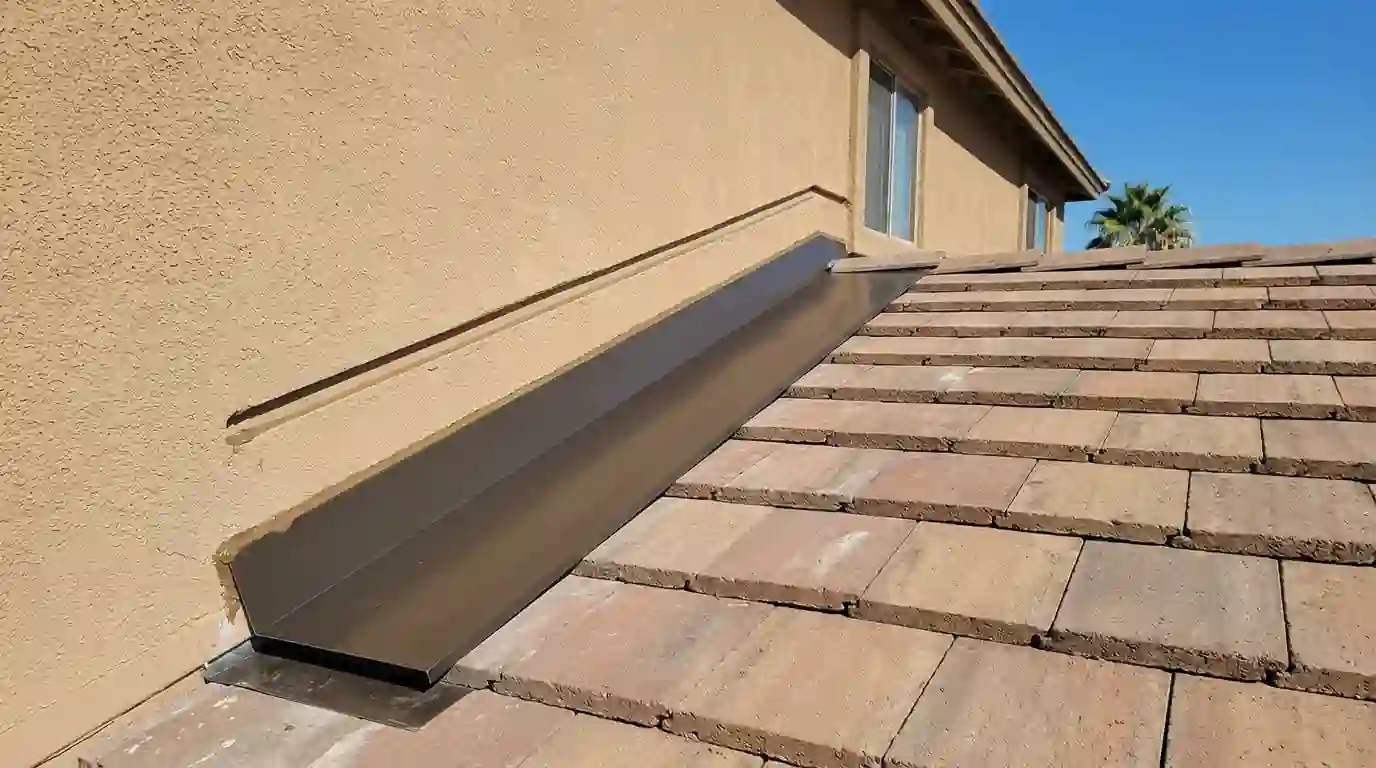
Cracked caulk along a wall
A bead of caulk where the roof meets stucco that has split or pulled away means the wall joint is open to wind-driven rain.
Roof Repair
Tile Roofing
Flat & Foam Roofing
Shingle & Metal Roofing
Replacement & Inspections
Solar, Vents & Extras
Phoenix neighborhoods
Valley cities
Counties
Roof Repair
Flashing is where most roofs fail first. The metal at walls, vents, valleys and chimneys moves with every hot day and cool night, and the sealant beside it dries out fast in Valley sun. We repair and replace flashing so the joints that leak most stay dry.
Short answer
Flashing is the metal that seals joints where the roof meets walls, vents, chimneys, skylights and other roof planes. In Phoenix, heat cycles crack the sealant and loosen the metal, and many homes have flashing that was only caulked to stucco. Repair means resetting or replacing the metal under the roofing and adding counterflashing where needed. Typical flashing repairs run $365 to $1,890, depending on location and roof type.
Materials we install and repair across the Valley
Roofing materials shed water well in the open field. The trouble is at every edge, corner and hole: where the roof meets a wall, where a pipe comes through, where two slopes meet in a valley. Flashing bridges those joints. It is usually galvanized steel, aluminum or lead, bent to direct water back onto the roof surface. On tile roofs, flashing sits under the tiles; on shingle, it weaves between courses; on foam, it is usually sprayed over and coated.
Phoenix is hard on flashing because of temperature swings. Metal on a south-facing wall can heat well past 150 F in summer afternoon sun, then cool quickly after dark. That expansion and shrinking works fasteners loose and splits any sealant that bridges metal to stucco. Flashing that is designed to move, with proper laps and counterflashing, lasts. Flashing that depends on caulk usually does not.
On repairs we match what is already on the roof, from Eagle and Westlake Royal concrete tile to GAF and Owens Corning shingles, and we seal flashing with roof-grade products from Henry and Tremco.
On a wall joint, the right setup has two pieces. Base or step flashing lays on the roof and turns up the wall. Counterflashing comes down from the wall and laps over it, so water running down the stucco is directed onto the roof and not behind it. On many Valley homes, the counterflashing was skipped and the base flashing was simply caulked to the stucco face. When that caulk fails, water runs straight behind the roofing.
Fixing it properly means cutting a reglet, a shallow groove, into the stucco and inserting counterflashing, or installing a surface-mounted counterflashing with a sealed top edge. It is more work than a caulk bead, but it is the fix that lasts. Where stucco damage is involved, we patch the cut so it blends. Along parapet walls on flat roofs, the same principle applies, which our parapet wall repair page covers in detail.
Plumbing vent boots are one of the most common leak sources on Valley roofs. The rubber collar cracks in the sun within a decade or so, sometimes sooner. We replace them with UV-resistant boots or lead jacks, and on tile roofs we install a proper flashing base under the tiles so the boot is not the only line of defense. Attic vents, exhaust fans and AC curbs get the same check.
Skylights have their own flashing kits, and many older skylights have curbs that were flashed with sealant only. If the skylight itself is cracked or fogged, our skylight repair and replacement work handles the unit, and we flash it as one job. Chimneys, which are less common here but still found on older homes, need step and counterflashing on all four sides plus a cricket on the uphill side if the chimney is wide.
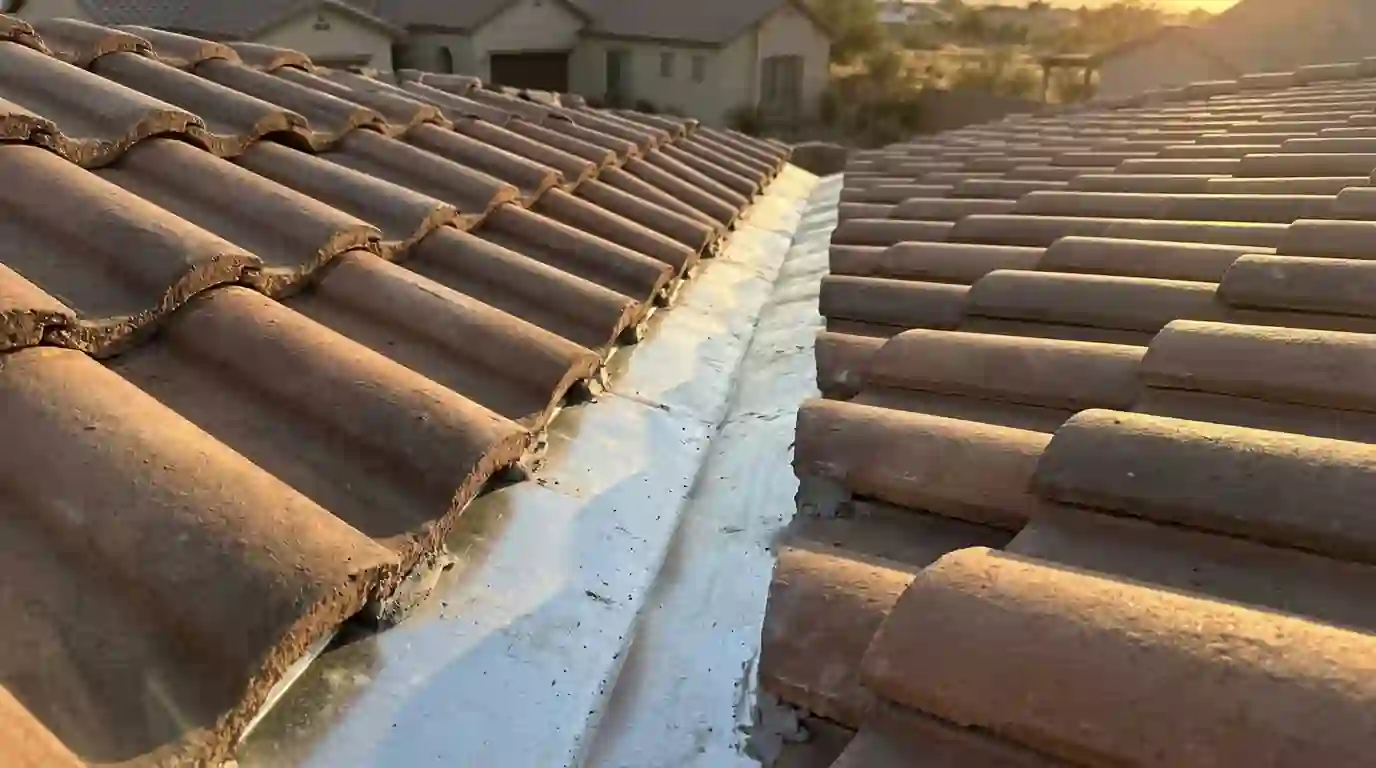
Open metal valleys carry the runoff from two slopes at once, so they move more water than any other part of a tile roof. In the Valley they also collect dust, leaves from palo verde and mesquite, and the occasional tennis ball. That buildup slows water down and pushes it sideways under the tiles that border the valley, which is why so many leaks start a foot or two from the valley center rather than in it.
When we repair a valley, we clear it fully, check the metal for rust and pinholes, and look at the felt under the edge tiles on both sides. Worn valley metal is replaced with a wider, heavier piece with a center rib that keeps water from crossing over. We cut edge tiles so they leave an open channel instead of crowding the metal, which keeps debris moving downhill.
Flashing problems tend to show up as leaks along walls or around penetrations. These are the signs that point to the metal rather than the roof field.
A bead of caulk where the roof meets stucco that has split or pulled away means the wall joint is open to wind-driven rain.
Rust streaks or pinholes in valley flashing show the metal is wearing through, and valleys carry more water than any other part of the roof.
Rubber or lead boots around plumbing vents crack in UV. A gap around the pipe lets water straight into the attic.
Interior stains below a chimney, skylight or AC curb usually trace to the flashing around that opening, not the roof covering.
Wind or foot traffic can bend flashing out from under tiles or shingles, leaving an edge for water to run behind.
When a room addition or patio was tied into the roof, the flashing at that joint is often improvised and fails first.
Typical range in the Phoenix area
$365 to $1,890
per flashing repair
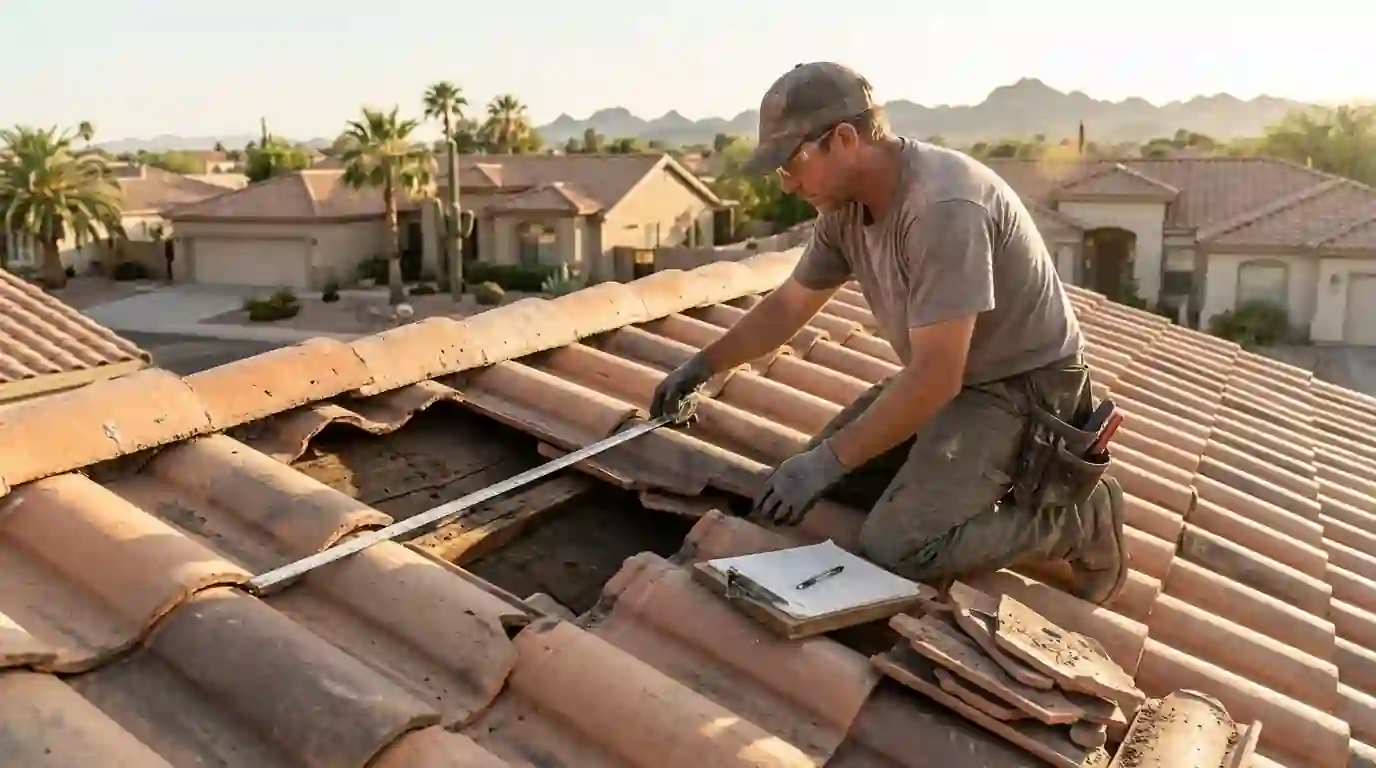
Flashing repairs are usually smaller jobs, but they vary with how much roofing must be lifted to reach the metal and whether counterflashing must be cut into stucco. The range below covers typical Valley flashing repairs. A single pipe boot sits near the low end.
Ranges are typical figures for Valley homes, not a quote. We price your roof after we see it.
Call (602) 878-3594 and tell us where the leak or stain appears. Locations near walls, vents or chimneys point us straight to the flashing.
We lift tiles or shingles around the flashing, or cut back coating on foam, to see the metal, the fasteners and the felt beneath.
Rusted or bent flashing is replaced with new metal; sound flashing is reset with proper laps and fasteners at every joint.
At wall joints, we add counterflashing into a reglet or with a sealed surface mount so water cannot run behind.
Tiles, shingles or foam and coating go back over the flashing, matched to the rest of the roof in profile and color.
You get photos of the flashing before and after so you can see what was wrong and how it was fixed.
Most of our roof flashing repair calls come from these parts of the Valley. We also cover every other area on our service area list, from Anthem and Cave Creek down to Casa Grande.
Caulk is a short-term seal. Daily heating and cooling stretch and compress it, and UV dries it out. In Valley sun, many caulks crack within a year or two. Proper flashing uses overlapping metal so water is directed out, with sealant only as a backup under cover.
Rubber boots often crack within 8 to 12 years in Phoenix sun, sometimes sooner on south-facing slopes. Lead jacks last much longer. We check boots on every repair visit and replace cracked ones while the tiles are already lifted.
Rarely. Flashing on a tile roof sits under the tiles, so the tiles must be lifted to reach it. We stack them carefully and relay the same tiles, replacing only broken ones. Lifting is what makes the fix last.
It can be. Water can enter through stucco cracks and run behind the flashing. We check both the flashing and the wall above it. A stucco crack may need patching before or alongside the flashing repair.
A cricket is a small peaked structure on the uphill side of a chimney or wide curb that splits water around it. Wide chimneys and AC curbs without one tend to collect debris and leak. We can add one during a flashing repair.
Roof leak repair in Phoenix: we trace the water to its true entry point on tile, foam, shingle or flat roofs and fix the cause. Call us 24/7.
Learn moreParapet wall repair in Phoenix for flat-roof Pueblo and territorial homes: caps, cracks and wall flashing fixed so water stays out. Call (602) 878-3594.
Learn moreLeaking, crazed or overheating skylight in Phoenix? We reflash curbs, replace sun-damaged domes and fit low-E units and sun tunnels. Call (602) 878-3594.
Learn moreTile roof leaking or tiles slipping in Phoenix? We trace the leak to the underlayment, reset or swap tiles and seal it the same week. Call (602) 878-3594.
Learn moreCall us any hour. A real person answers, asks a few questions about your roof and sets up a visit.