Drips along the house wall
Water running down the stucco or dripping where the cover meets the house almost always means the ledger flashing has failed or was never installed.
Roof Repair
Tile Roofing
Flat & Foam Roofing
Shingle & Metal Roofing
Replacement & Inspections
Solar, Vents & Extras
Phoenix neighborhoods
Valley cities
Counties
Solar, Vents & Extras
Most patio cover leaks start where the cover meets the house. We reroof flat and low-slope patio covers, rebuild the flashing at the ledger, seal aluminum panel covers and make sure water runs off the patio instead of into your wall.
Short answer
Most Phoenix patio cover leaks start at the ledger, the board or bracket where the cover attaches to the house wall, or at the low-slope roofing on the cover itself. We fix them by reflashing the ledger so water is carried away from the stucco, replacing worn rolled roofing, foam or coating on the cover, and sealing seams on aluminum panel covers so monsoon rain drains off the edge.
Materials we install and repair across the Valley
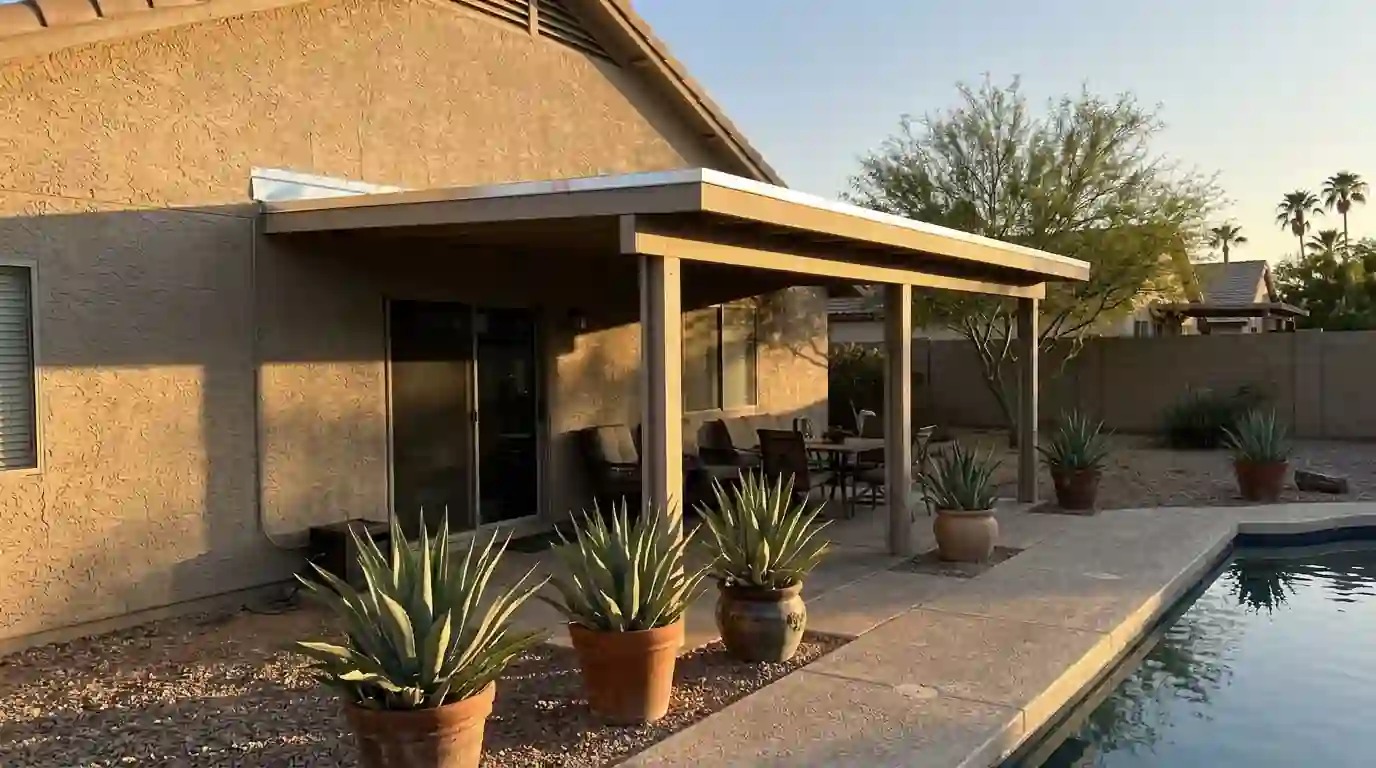
A patio cover is attached to your house along a ledger, a board bolted to the wall or a bracket fastened to the fascia, with rafters or panels running out to posts. Rain hitting the main roof often drains straight onto the patio cover, and the joint at the ledger is where it most likely gets in. On a lot of Valley homes, especially covers added after the house was built, that joint has little more than caulk holding water out. Caulk shrinks in Phoenix heat, and the next monsoon storm sends water behind the stucco.
Doing it right means flashing the ledger with metal that tucks behind the wall finish above it and laps over the patio roofing below. On stucco walls, that can mean cutting a clean line into the stucco to set a counter-flashing, then sealing it so water follows the metal down and out. Where the patio cover ties into the main roof at the eave, we flash that junction the same way we would any roof-to-wall transition.
Skylight work uses units from makers such as Velux, and the flashing and sealants we use around panels, vents and patio covers come from Henry and Tremco roof lines.
Wood-framed patio covers built with the house often carry the same low-slope roofing as other flat sections: rolled roofing, built-up layers, foam or a coated membrane. These go through Phoenix UV fast because they're thin and lie nearly flat. When a patio cover roof is worn out, we tear it off to the deck, repair any rotted sheathing, and install a new membrane or foam system with a proper drip edge so water drains off the edge instead of curling back under.
Foam works well on patio covers that tie into a foam main roof, since the two can be sprayed as one continuous system with no seam at the house. Modified bitumen and TPO are good choices for covers that need a membrane. On covers where heat on the patio matters, a reflective coating makes the space below noticeably cooler. For a coating-only refresh on a sound surface, see our elastomeric coating page.
Many Valley homes have aluminum patio covers, including the wood-look style many people know by brand name, and insulated foam-core panel covers. These don't use roofing in the usual sense. The panels interlock or overlap, and water is kept out by the panel profile, screws with sealing washers and sealant at seams and the house connection. After years of heat, the sealant shrinks, washers dry out and screws back out as the panels expand and contract.
We go seam by seam, replacing failed sealant with a product rated for aluminum and UV, swapping worn screws and washers, and resealing the house connection with new flashing where it's missing. Bent or dented panels from monsoon winds can often be replaced one at a time. If a patio cover is beyond repair, we can rebuild the roof surface or talk through replacement options. And if water is getting into the house itself, tracing the leak into the main roof comes first.
Patio covers take as much sun as the main roof but usually get far less attention. Watch for these, especially right after the first monsoon storms of the season.
Water running down the stucco or dripping where the cover meets the house almost always means the ledger flashing has failed or was never installed.
Water sitting on a flat patio cover for days after a storm means the slope has sagged or drains are blocked, which wears out the roofing faster.
Rolled roofing, built-up layers or coatings on patio covers crack and blister in Valley sun, opening paths for rain into the framing below.
Dark stains, peeling paint or sagging boards on the patio ceiling mean water has been getting into the framing for a while.
Loose screws, failed seam sealant or bent panels on aluminum covers let in rain and rattle in monsoon winds, and can get worse in each storm.
Cracked, bubbled or crumbling stucco below where the patio cover attaches is a sign that water has been running behind the wall finish.
Typical range in the Phoenix area
$545 to $4,380
per patio cover, repair to full reroof
A ledger reflash or seam reseal on a small aluminum cover sits at the low end. A full tear-off and reroof of a large wood-framed cover, with sheathing repair and new flashing at the house, sits at the high end. Stucco patching after a ledger repair is included only when it's part of the flashing work.
Ranges are typical figures for Valley homes, not a quote. We price your roof after we see it.
Call (602) 878-3594 any hour. Tell us the cover type, where you see water and whether it's leaking into the house, and we'll schedule the right visit.
We check the patio roof surface, framing, ledger, flashing and the main roof above to find where water is actually getting in.
You get a clear choice between a targeted repair, such as reflashing the ledger, and a full reroof of the cover, each with a price.
Worn roofing comes off, rotted boards are replaced, and the ledger area is cleaned and opened up so new flashing can go behind the wall finish.
New roofing, foam or coating goes down, ledger and wall flashing are installed, and aluminum seams and fasteners are resealed or replaced.
We run water over the cover and the ledger joint, check underneath for drips, and clear debris from the patio, yard and pool area.
Most of our patio cover roofing calls come from these parts of the Valley. We also cover every other area on our service area list, from Anthem and Cave Creek down to Casa Grande.
That pattern almost always points to the ledger, where the cover is attached to the house. If the joint relies on caulk alone, or the flashing was never tucked behind the stucco, rain from the main roof runs down the wall and gets in there. Reflashing that connection usually stops the leak without redoing the whole cover.
Yes, if the patio cover framing can carry it and the slope drains properly. Spraying the patio cover as part of the main foam roof removes the seam at the house where leaks start. The foam then gets the same protective coating as the main roof and follows the same recoat schedule.
Yes, less than wood but not none. Sun and heat dry out seam sealant and the rubber washers under screws, and monsoon winds loosen fasteners. A check every few years, resealing seams and replacing worn screws, keeps rain out and stops panels from rattling or lifting in storms.
Water that sits for more than a day or two after a storm speeds up wear on roofing, adds weight to the framing and can find its way through small cracks. Ponding usually means the cover has sagged or a drain is blocked. We can rebuild the slope or add drainage at the low edge.
It depends on the city and on what's being changed. Simple repairs usually don't, while structural changes or full replacement may. HOA rules can also apply to materials and colors on covers visible from the street. We check what applies to your address before work starts.
Flat roof leaking in Phoenix? We find the source on foam, built-up, mod bit or TPO roofs and fix ponding, seams and drains. Call (602) 878-3594 24/7.
Learn moreRoof flashing repair in Phoenix: we fix the metal at walls, valleys, vents and chimneys where most roof leaks start. Call (602) 878-3594 any hour.
Learn moreSpray foam roofing for flat and low-slope Phoenix homes: one continuous insulating layer sloped to drain, with a UV top coat. Call (602) 878-3594 24/7.
Learn moreAcrylic elastomeric roof coating for Phoenix flat, foam and metal roofs: bright white, flexible in heat, fairly priced. Call (602) 878-3594 any time.
Learn moreCall us any hour. A real person answers, asks a few questions about your roof and sets up a visit.