Water sheeting over entries
Rain pouring off the eave above a front door, garage or walkway means visitors get soaked and water splashes onto stucco, doors and thresholds.
Roof Repair
Tile Roofing
Flat & Foam Roofing
Shingle & Metal Roofing
Replacement & Inspections
Solar, Vents & Extras
Phoenix neighborhoods
Valley cities
Counties
Solar, Vents & Extras
Monsoon storms can dump a lot of water on a roof in a short burst, and if it pours off the eaves onto stucco, doorways or the foundation, you'll see the damage. We install, repair and extend gutters and downspouts where they help, and we'll tell you honestly where they don't.
Short answer
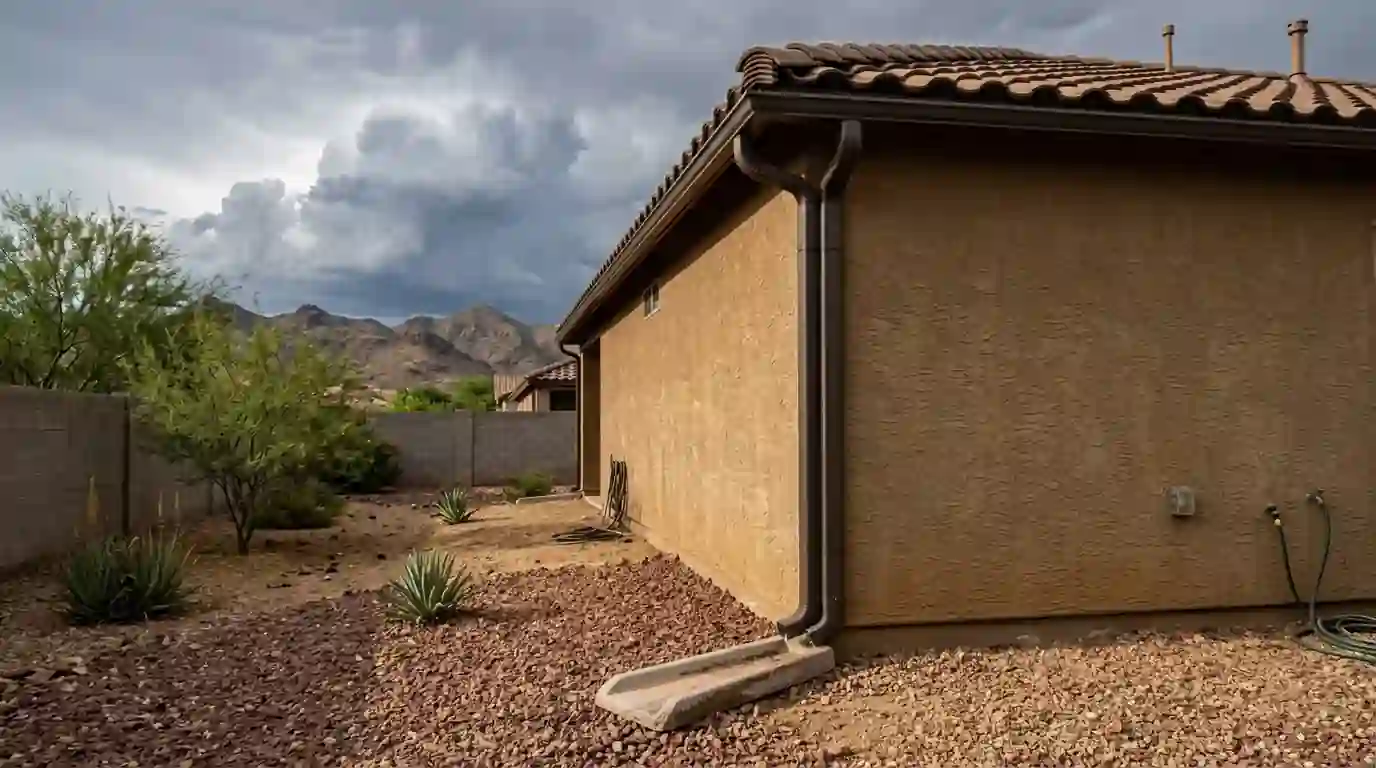
Not every Phoenix home needs gutters all the way around. Most Valley homes need them where roof runoff lands on entries, walkways, patios, stucco walls or soil near the foundation. We often install partial gutters on those runs, size downspouts for monsoon downpours and add extensions or splash blocks so water gets carried away from the house instead of soaking the ground beside it.
Materials we install and repair across the Valley
Honestly, not always all the way around. A lot of Valley homes were built with partial gutters or none at all, and many get by fine because it rains so few days a year. Where the roof overhang is generous, the ground slopes away and runoff lands on gravel well clear of the walls, adding gutters may do very little. We'd rather tell you that than sell you a full system you don't need.
Where gutters do earn their keep is anywhere runoff causes trouble: over entries and garage doors, above walkways and patios, along walls where splash-back stains stucco, and above soil where water soaking in next to the slab can cause settling. Tile roofs with valleys can concentrate a monsoon downpour into one spot, and that spot is often right over a door. Partial gutters on those runs, sized correctly and discharging somewhere sensible, solve most of the problems we see.
Skylight work uses units from makers such as Velux, and the flashing and sealants we use around panels, vents and patio covers come from Henry and Tremco roof lines.
Phoenix rain comes in bursts. A monsoon cell can drop a lot of water in fifteen minutes, and a gutter that would be fine in a steady drizzle overflows almost at once. We size gutters for the roof area draining into them, favoring 6 inch continuous aluminum, formed on site with no joints along the run, on larger runs and tile roofs, and we add downspouts rather than relying on one at the end of a long run. More downspouts mean less water in any single gutter section.
Where the water goes is just as important. Downspouts should discharge onto splash blocks, into extensions that carry water several feet from the house, or into landscaping set up to take it, never straight down beside the foundation. On homes with flat or foam roofs, scuppers and canales do the job gutters do on pitched roofs, and those details need their own care. Our scupper and canale repair page covers that side.
Many gutter complaints turn out to be fixable without replacing anything. Joints that leak get resealed, sections that sag get rehung with hidden hangers spaced closer together, and downspouts crushed by a lawn mower or a stray car get replaced. After a haboob, gutters can fill with fine dust that turns to mud in the next storm, so a cleanout and flush is often the first step. We also check that every section still pitches toward its downspout, since a run that has settled flat will hold standing water and grit between storms.
Gutters also depend on the fascia behind them. If the fascia board is rotted from years of overflow, new gutter hangers won't hold. We check the fascia while we're on the ladder and repair fascia and soffit damage before rehanging. And if water damage around the house is happening during monsoon storms in general, our monsoon roof prep checklist walks through what else to check before the season starts.
Gutter problems show up as water damage around the house more than on the roof itself. These are the clues we look for after a storm.
Rain pouring off the eave above a front door, garage or walkway means visitors get soaked and water splashes onto stucco, doors and thresholds.
Dark streaks, efflorescence or crumbling at the base of stucco walls point to roof runoff splashing against the house storm after storm.
Channels carved into landscape rock or soil under the roof edge show exactly where heavy runoff hits, often right next to the foundation.
Water spilling over the gutter edge in a downpour means the gutter is too small, the downspouts are too few or the system is clogged.
Gutters drooping away from the fascia, or with gaps at the joints, can't carry water and may pull the fascia board loose over time.
A downspout that empties right at the foundation without an extension or splash block just moves the problem a few feet over.
Typical range in the Phoenix area
$415 to $3,270
from repairs to partial or full gutter runs
Gutter pricing depends on the length of the runs, gutter size, number of downspouts and fascia condition. Repairs and partial gutters over a few entries sit at the low end. Full one-piece systems around larger two-story homes sit at the high end. Fascia repair, if needed, is priced separately.
Ranges are typical figures for Valley homes, not a quote. We price your roof after we see it.
Call (602) 878-3594, day or night. Tell us where water is causing trouble and whether you have gutters now, and we'll schedule a visit.
We look at the roof's valleys and slopes, then walk the house to see where runoff lands, what it's damaging and where it could safely go instead.
You get a plan showing which runs need gutters, where downspouts go and what can be left alone, with an honest note if gutters won't help.
Any rotted fascia board or loose trim along the planned gutter runs is repaired so hangers have solid wood to fasten into.
One-piece gutters are formed on site to length, hung with hidden hangers, pitched toward downspouts and sealed at corners and end caps.
Downspout extensions, splash blocks or connections to landscape drainage are set so water leaves the house, then we flush the system to test it.
Most of our gutter installation & repair calls come from these parts of the Valley. We also cover every other area on our service area list, from Anthem and Cave Creek down to Casa Grande.
Maybe not everywhere. Many Phoenix homes only need gutters where runoff lands on entries, patios, walkways, stucco walls or soil next to the foundation. If water already drops onto gravel well away from the walls and the ground slopes away, gutters on that side may not be worth it. We'll tell you which runs actually matter.
For most Valley homes, 6 inch continuous gutters with plenty of downspouts handle monsoon bursts better than 5 inch gutters with one downspout at the end. Tile roofs with valleys concentrate a lot of water in a few spots, so larger gutters and extra downspouts near those valleys help prevent overflow.
They can help a lot. Splash-back from runoff hitting the ground stains and erodes the bottom of stucco walls. Gutters with downspouts carrying water away from the wall keep that area much drier. Existing stucco damage may still need repair, but the cause will be gone.
Usually once or twice a year, and especially before monsoon season starts in mid June. Dust from haboobs, leaves from nearby trees and tile roof grit collect in gutters and turn to mud in the first storm. Homes under mesquite, palo verde or eucalyptus trees may need cleaning more often.
Yes. Gutters on tile roofs hang from the fascia below the tile edge, so the tiles themselves aren't disturbed. We set the gutter so water dropping off the tile lands in it, and we use hidden hangers fastened into solid fascia rather than straps that slide under the tiles.
Fascia and soffit repair in Phoenix: sun-split boards, rot from roof leaks and pigeon damage fixed and sealed to match your trim. Call (602) 878-3594.
Learn moreScupper and canale repair in Phoenix: we clear, reflash and rebuild the wall drains on flat roofs so monsoon water leaves fast. Call (602) 878-3594.
Learn moreMonsoon storm damage repair in Phoenix: we tarp, document and fix roofs hit by microbursts, haboobs and flying debris. Call (602) 878-3594.
Learn moreRoof maintenance plans for Phoenix homes: a spring check before the heat and a post-monsoon visit to catch storm damage early. Call (602) 878-3594.
Learn moreCall us any hour. A real person answers, asks a few questions about your roof and sets up a visit.