Ceiling stain after a storm
A brown ring on drywall after rain means water got past the tile and the felt below it. The stain often sits a few feet from the actual entry point.
Roof Repair
Tile Roofing
Flat & Foam Roofing
Shingle & Metal Roofing
Replacement & Inspections
Solar, Vents & Extras
Phoenix neighborhoods
Valley cities
Counties
Tile Roofing
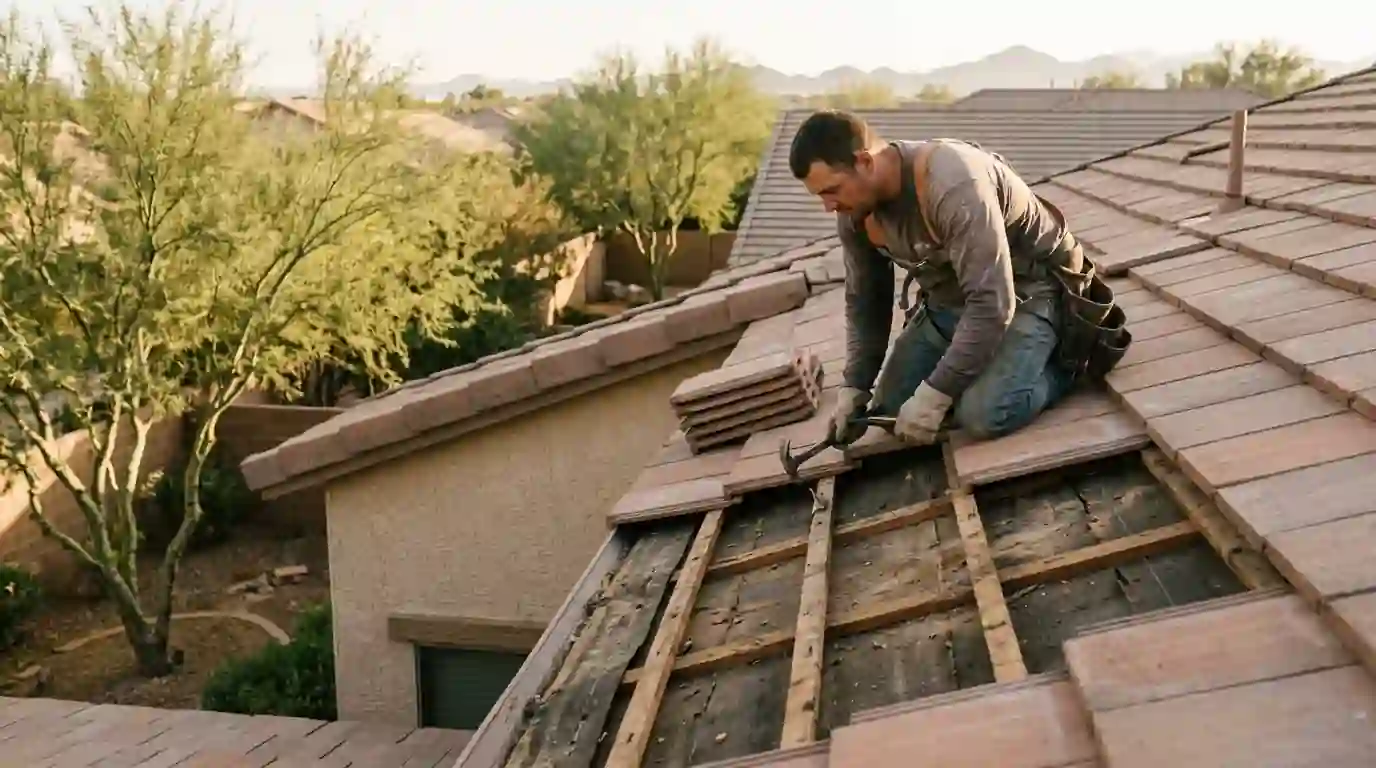
A tile roof that leaks is almost never a tile problem alone. Water gets past cracked or slipped tiles and finds tired felt underneath. We lift the tiles around the trouble spot, fix what is actually failing below, and set everything back so it sheds the next storm.
Short answer
Most tile roof leaks in Phoenix come from cracked or slipped tiles, worn underlayment at a valley or penetration, or flashing that has pulled away. A targeted repair means lifting the tiles in that area, patching or replacing the underlayment section, refastening or replacing tiles, and resealing flashing. When the felt is brittle across the whole roof, repairs buy time but a full underlayment replacement is the lasting fix.
Materials we install and repair across the Valley
Tile hides its problems well, so the clues usually show up inside the house or from the ground. Any of these is worth a call before monsoon season.
A brown ring on drywall after rain means water got past the tile and the felt below it. The stain often sits a few feet from the actual entry point.
A tile that has slipped down the course leaves a gap above it where rain runs straight onto the underlayment. Broken nails and failed hurricane clips are the usual cause.
Tiles around AC units, satellite mounts and solar arrays crack from foot traffic. Each crack funnels water to the same small patch of felt every storm.
If you see light around a vent pipe or find a fan of dust after a haboob, something at that penetration has opened up and needs resealing.
Leaves, palm fronds and blown dirt pack into valleys and hold water against the metal. Overflow then runs sideways under the tile edges.
Loose or missing mortar at ridges and hips lets wind lift the caps and lets rain drive into the peak of the roof.
Phone (602) 878-3594 and tell us where the stain is and when it shows up. If water is coming in right now, we talk through tarping or containment first.
A roofer walks the tile and looks in the attic above the stain. We photograph the felt, flashing and any broken tile so you can see what we see.
You get the cause, the fix, and a price range on the spot. We also say whether the rest of the underlayment looks like it has years left.
Tiles come up in order, the felt, battens and flashing get repaired, and sound tiles go back. Broken ones are swapped for the closest match we can source.
Where it helps, we run a hose over the repaired area to confirm it sheds water. Broken tile and debris leave with us, and valleys get cleared on the way out.
On a concrete tile roof the tile is mostly a sun shield and a first barrier. The real waterproofing is the underlayment, usually 30 lb felt on older Valley homes, stapled to the deck under the battens. Tiles crack, slip or get stepped on, and that exposes a patch of felt to direct sun and rain. Felt that has baked at 160 degrees for fifteen summers turns brittle, and one storm is enough to open a split. That is why we never just glue a broken tile back down and leave.
The other common entry points are the transitions: valleys where two roof planes meet, the pan flashing around a chimney or wall, the boots around plumbing vents, and the edges of skylights. In our experience across Phoenix, valleys cause more interior stains than anything else, because they carry the most water and collect the most debris. If you also have flat sections, a leak can start there and travel; our low-slope leak repair page covers that side of things.
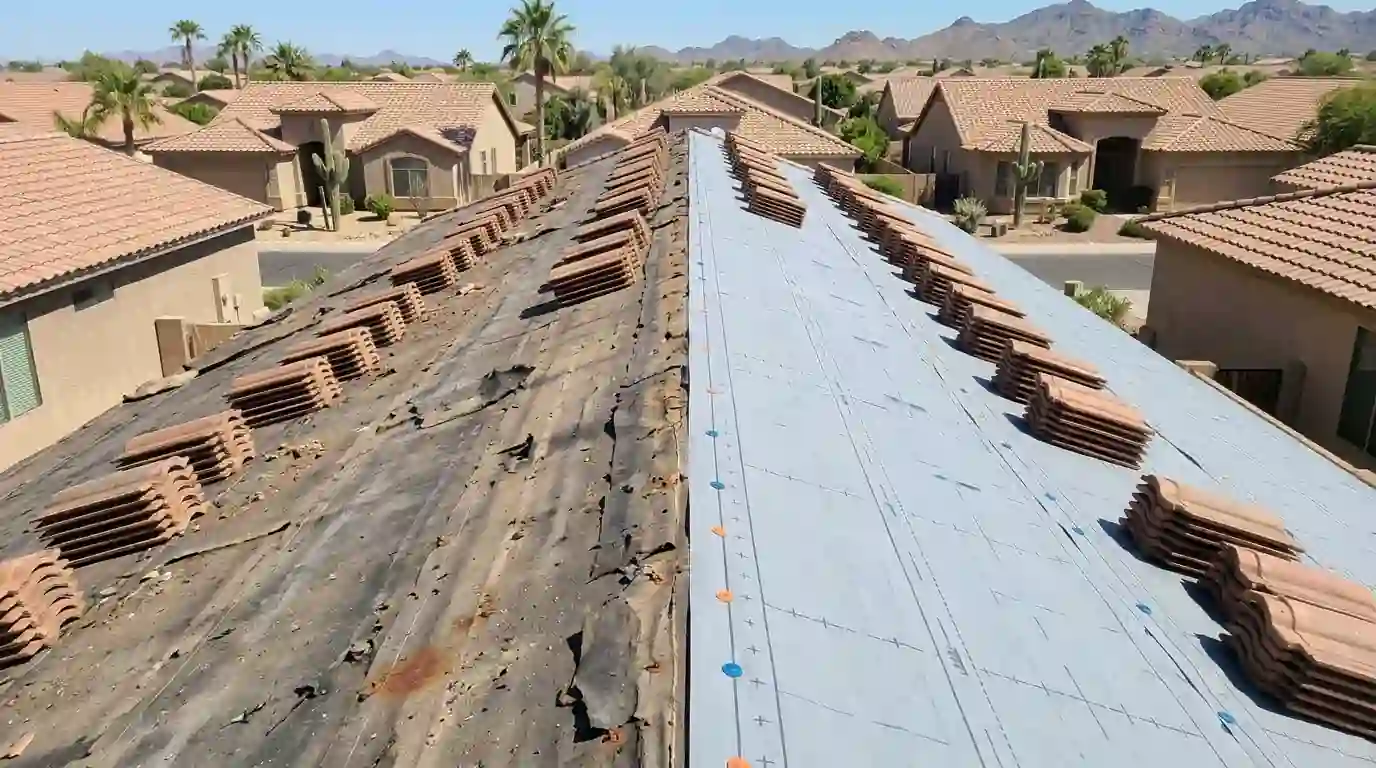
For tile work we source concrete tile from Eagle Roofing and Westlake Royal when a profile is still made, and we lay synthetic or two-ply underlayment from makers such as Polyglass under it.
Walking a tile roof carelessly breaks tile, so our roofers step on the lower third of each tile where it rests on the one below, and we carry spare tile to the job. We pull the courses above and around the leak, stack them in order, and look at the felt, the battens and the deck. Small tears get patched with a compatible underlayment lapped correctly, never just caulked. Rotted batten sections get replaced, and soft decking gets cut out and renewed.
Then the tiles go back in their original order, with new fasteners or clips where the old ones failed. Cracked pieces get swapped for a matching profile. Flashing is refastened or replaced and sealed with a product rated for roof heat. If a specific tile needs matching, our single tile replacement service covers the color and profile hunt in detail.
A repair is the right call when the felt around the leak is still pliable and the rest of the roof is in decent shape. We judge that by lifting a few tiles in other spots, usually on the south and west faces where the sun hits hardest. If the felt there tears like paper when you bend it, every repair is a patch on a failing system, and you will be calling again next monsoon.
Underlayment under concrete tile commonly wears out around 20 to 25 years in Valley heat, while the tiles themselves can last much longer. Plenty of homes built in the late 1990s and early 2000s are hitting that window now. When we see it, we tell you plainly, explain the cost of patching versus a full lift-and-relay underlayment job, and let you decide. Sometimes a repair this year and a planned replacement next spring is the sensible order.
Typical range in the Phoenix area
$415 to $1,860
per typical repair visit
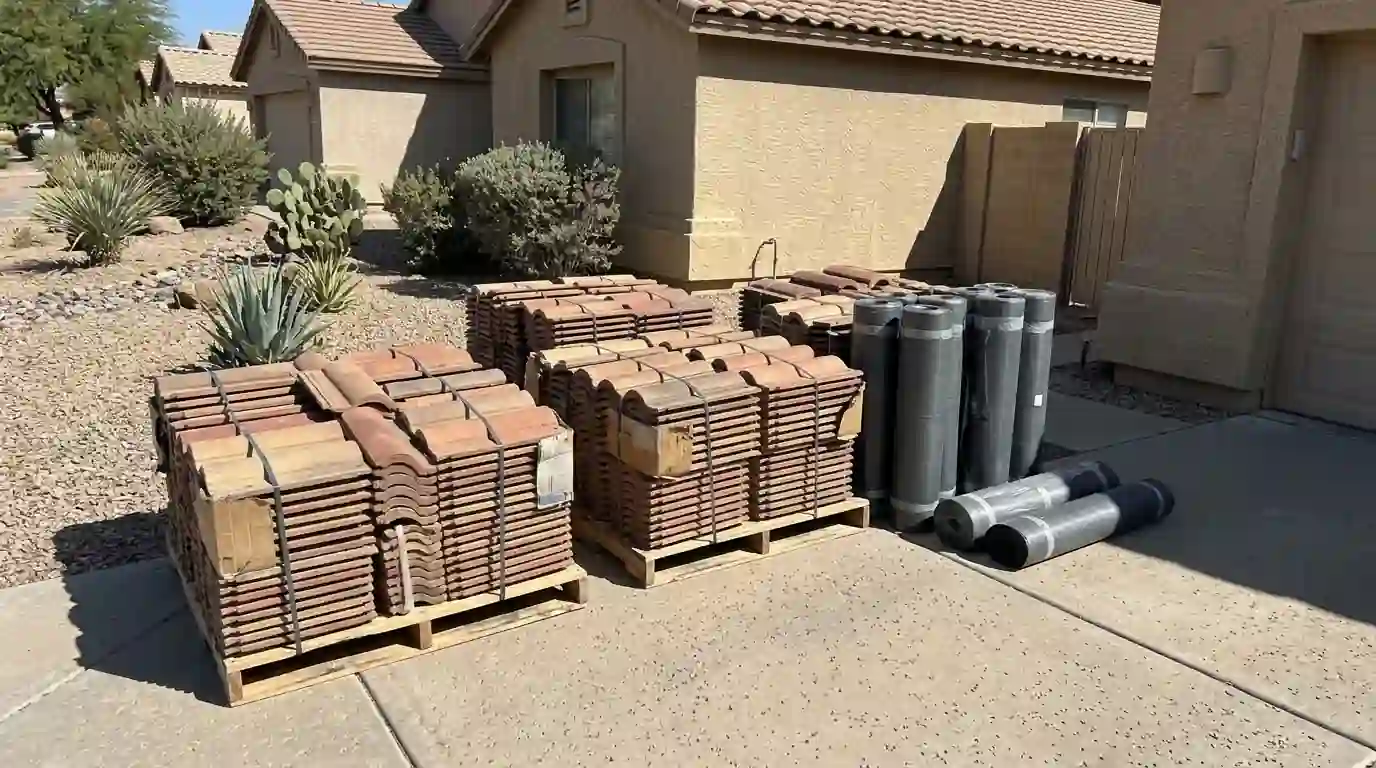
Most tile repairs in the Valley land in a predictable range, but the final number depends on how much tile has to come up and what we find underneath. Steep or two-story roofs take longer to stage safely, and hard-to-match tiles add sourcing time.
Ranges are typical figures for Valley homes, not a quote. We price your roof after we see it.
Most of our tile roof repair calls come from these parts of the Valley. We also cover every other area on our service area list, from Anthem and Cave Creek down to Casa Grande.
Yes, and it happens often in Phoenix. The tiles can look perfect from the street while the felt underneath has split from heat. Water that blows in at a gap or under a ridge then reaches the deck. We lift tiles at the stain location to see the underlayment directly instead of guessing from the ground.
We would not. Caulk on a cracked tile fails within a summer or two in Valley sun, and walking the roof to apply it usually breaks more tiles. The crack is also rarely the whole story, since the felt beneath has been exposed. A proper repair replaces the tile and checks the layer underneath.
We answer 24/7, and during active storms we prioritize water coming into living space. If a full repair cannot be done safely in wind or lightning, we secure the area with a tarp or temporary patch and come back to finish the permanent repair once the weather clears.
It depends on the felt, not the tile. If the underlayment still bends without cracking, a repair is reasonable and can carry you several more years. If it crumbles in our hands on multiple slopes, we will tell you a repair is short-term and give you the numbers for underlayment replacement too.
We aim for an exact match, starting with the manufacturer and profile stamped on the back of your tiles. When a color is discontinued, we can borrow tiles from a hidden slope and put new ones there, so the visible faces stay consistent. Sun-faded tiles may still differ slightly at first.
Tiles fine but the felt under them is shot? We lift and relay Phoenix tile roofs with new two-ply or synthetic underlayment. Call (602) 878-3594 any time.
Learn moreCracked or missing roof tiles in Phoenix? We match the profile and color, replace single tiles and check the felt below. Call (602) 878-3594 day or night.
Learn moreRoof leak repair in Phoenix: we trace the water to its true entry point on tile, foam, shingle or flat roofs and fix the cause. Call us 24/7.
Learn moreRoof flashing repair in Phoenix: we fix the metal at walls, valleys, vents and chimneys where most roof leaks start. Call (602) 878-3594 any hour.
Learn moreCall us any hour. A real person answers, asks a few questions about your roof and sets up a visit.