Water still standing two days later
A shallow puddle gone by the next afternoon is normal. Water still sitting after about 48 hours means the roof has a low spot or a blocked path.
Roof Repair
Tile Roofing
Flat & Foam Roofing
Shingle & Metal Roofing
Replacement & Inspections
Solar, Vents & Extras
Phoenix neighborhoods
Valley cities
Counties
Flat & Foam Roofing
A flat roof that holds water for days after a storm is wearing out faster than it should. We find where the water stops, build crickets and tapered slope to move it, and open up scuppers and canales so the next monsoon downpour leaves the roof quickly.
Short answer
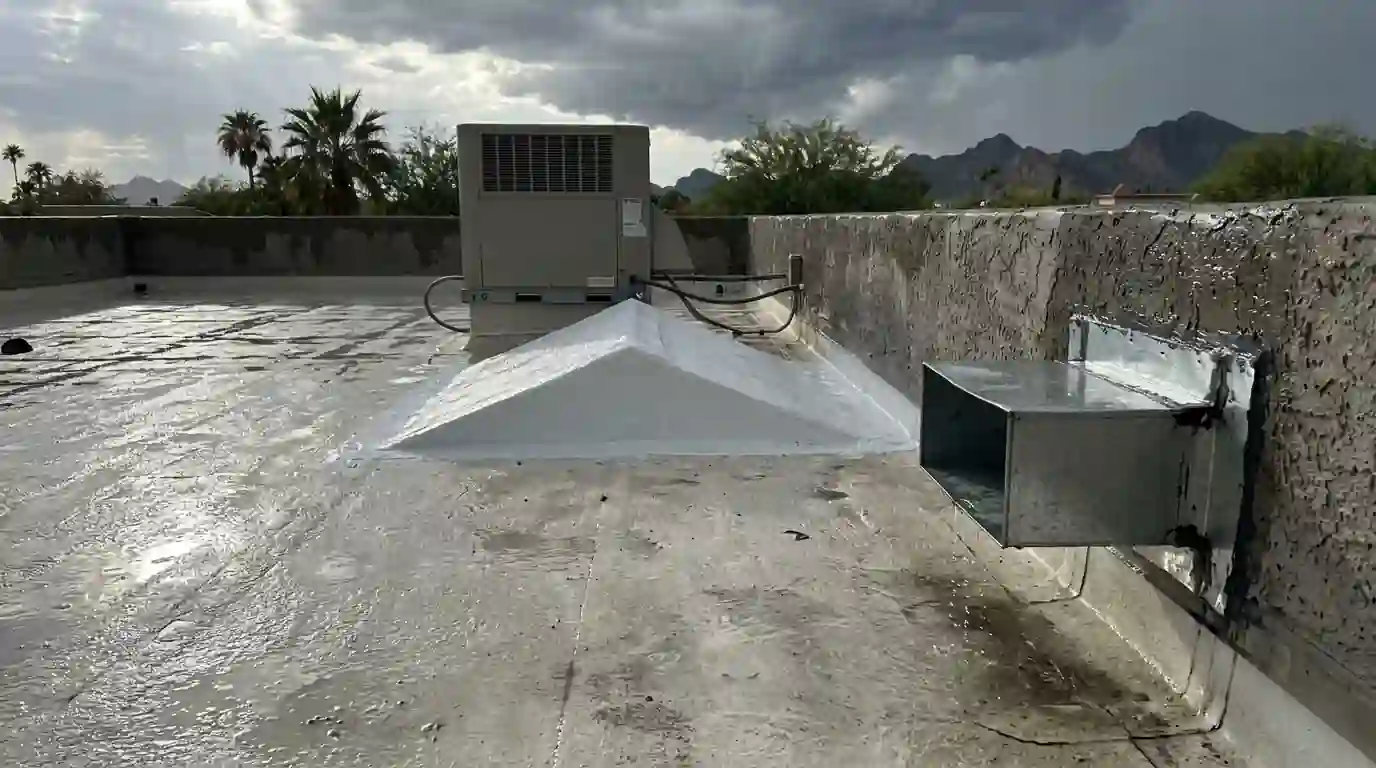
A cricket is a small sloped ridge built on a roof to split water around something that blocks it, such as a chimney, a cooler curb or the high side of a parapet wall. On Phoenix flat and low-slope roofs, we pair crickets with tapered insulation or added foam to create real fall toward the drains, then enlarge or add scuppers so water clears the roof within a day or two of a storm.
Materials we install and repair across the Valley
Flat roofs in Phoenix are supposed to slope gently toward scuppers or drains, but many were framed with very little fall, and decks sag over the decades. Add a parapet on every side, a cooler curb in the middle and an AC unit or two, and water has a lot of obstacles to work around. Most of the year that doesn't matter. Then a monsoon cell drops a big share of the summer's rain in under an hour, and every flaw in the slope fills at once.
Ponding isn't just cosmetic. Standing water concentrates sun on the coating, adds weight to the deck, and finds any seam or crack sitting under it. Dust from haboobs settles in the wet areas and turns to mud that holds moisture even longer. Over a few seasons, the low spots become the first places to leak. If water is already coming through the ceiling, our flat roof leak repairs handle the damage while we sort out the slope that caused it.
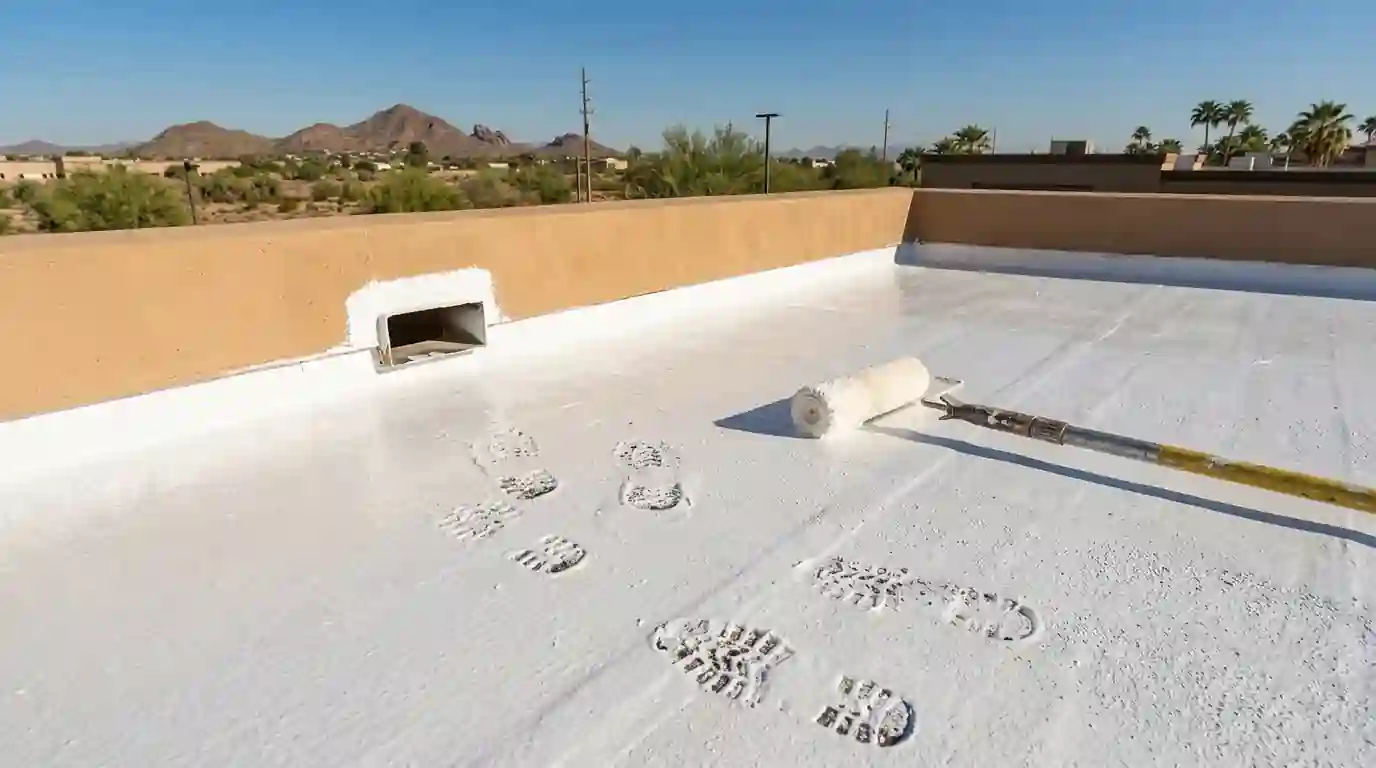
On flat and foam roofs we use coating systems from Gaco, Henry and Tremco, and single-ply membranes such as Carlisle TPO where a membrane is the better fit.
A cricket, sometimes called a saddle, is a small peaked ridge built on the high side of whatever blocks the water. Behind a chimney on a sloped roof, it pushes water off to both sides instead of letting it pool against the masonry. On flat roofs, we build them behind cooler curbs, AC stands, skylight curbs and long runs of parapet wall, and between two scuppers so water has a clear line to each. The ridge and slopes are sized to the obstacle and to the roof area draining toward it.
On wood-framed sloped roofs, crickets are usually framed with lumber, decked, then covered with the same roofing as the field so they're part of the system. On flat roofs, they're more often cut from tapered insulation board or built up with sprayed foam. Every cricket needs flashing where it meets the wall, chimney or curb, since that joint is the first place water reaches. We see plenty of crickets built without it, which just moves the leak a few feet over.
Where ponding covers a wide area, a cricket alone won't solve it. Tapered insulation is rigid board manufactured with a built-in slope and laid out in a planned pattern so the whole roof falls toward its drains, then covered with new membrane. On foam roofs, we build slope by spraying extra foam in the low areas, since foam goes on in layers and can be shaped across the surface. Both approaches add some height, so we check that parapet flashing, door thresholds and scupper liners will still sit right.
Moving water to the edge only works if it can get out. Many older homes have one or two small scuppers for a large roof, or canales narrowed inside by rust and debris. We enlarge undersized scuppers, add new ones at low corners, and fit an overflow scupper set slightly higher than the main one as a backup for the biggest storms. Openings that are rusted or leaking go through our scupper and canale repair work so the whole drainage path is sound.
Adding slope to a roof near the end of its life can mean paying twice. If the membrane or foam is worn across the whole surface, building crickets and tapered areas on top of it buries tired material under new work. In that case we usually suggest folding the drainage design into a full flat roof replacement, where the tapered system goes down over the bare deck and every scupper is set to the new surface height from the start.
When the roof still has years left, targeted drainage work makes a lot of sense. A single cricket behind a cooler curb, or one new scupper at a low corner, can end a ponding problem that has been eating through coatings for years. After looking at the roof, we'll tell you which situation you're in and why, so you can decide based on what's actually up there rather than on a guess.
Drainage trouble shows up in the days after a storm, when everything else has dried out. Walk the roof edge or look from a second-story window for these.
A shallow puddle gone by the next afternoon is normal. Water still sitting after about 48 hours means the roof has a low spot or a blocked path.
Ponding leaves a ring of dust and silt behind when it finally evaporates. Haboob dust makes these rings easy to spot on light-colored coatings.
Anything sitting across the slope dams water on its high side. That's exactly where a cricket belongs and where leaks most often start.
Water that collects along a parapet wall instead of moving to a scupper soaks the flashing and stucco, and leaks show up along interior walls.
If water sheets over the parapet or shoots past the canale during a heavy cell, the opening is too small for the roof area draining into it.
Coatings break down fastest where water sits. Blisters, peeling or algae patches in one area usually mark the lowest spot on the roof.
Typical range in the Phoenix area
$785 to $5,940
for most residential drainage projects
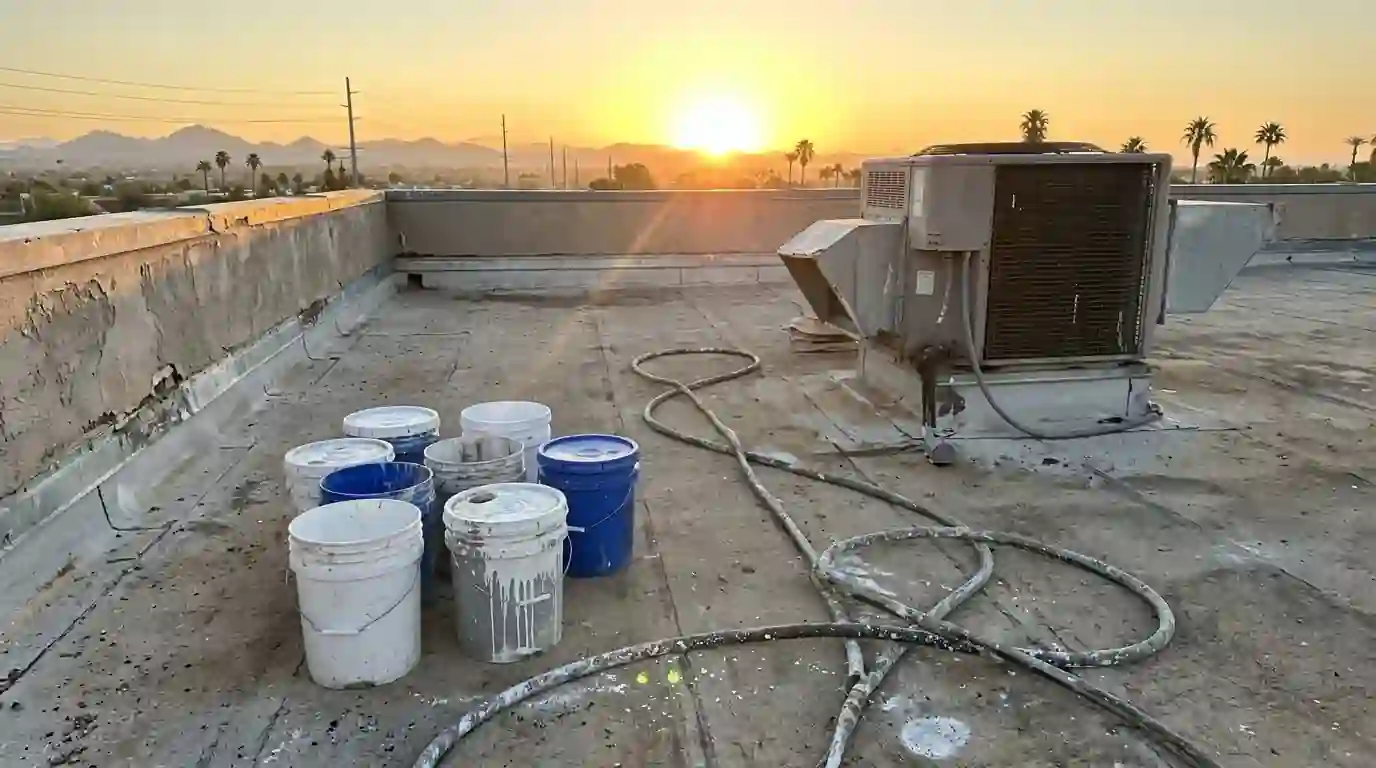
Drainage work ranges widely because some roofs need one cricket and others need slope built across the whole surface. A single cricket behind a cooler curb with one new scupper sits near the bottom. Tapered systems across a large ponding area with several new scuppers sit near the top, and very large roofs can run past it.
Ranges are typical figures for Valley homes, not a quote. We price your roof after we see it.
Call (602) 878-3594 day or night, ideally while water is still standing. Photos of the ponding from a window or ladder help us read the pattern.
We walk the roof, mark ponding areas and dirt rings, measure the fall toward each drain, and note every curb, wall and unit blocking the water.
We lay out where crickets, tapered board or added foam go and whether scuppers need enlarging or adding, then walk you through the plan and price.
Crickets are framed or cut from tapered board, extra foam is sprayed where needed, and each piece is fastened and tied into the existing roof.
Scuppers are enlarged or added, liners flashed into the roof and parapet, and canales cleared or replaced so water has a clear way off.
We run water across the roof to confirm it reaches the drains, cover new work with matching membrane or coating, and share photos of the result.
Most of our roof drainage & cricket installation calls come from these parts of the Valley. We also cover every other area on our service area list, from Anthem and Cave Creek down to Casa Grande.
Most roofers use about 48 hours as the line. Water that dries within a day or two of a monsoon storm is usually fine. Water that sits longer, or returns to the same spot every storm, is breaking down the coating and needs slope or drainage work before it leaks.
Building codes commonly call for one when a chimney is wider than about 30 inches across the slope, since water and debris pool on its high side. Many older Valley homes with fireplaces never got one, and the result is rotted decking and leaks at the back of the chimney. We can add one during a repair or a re-roof.
Yes, by a few inches at the high points, so we check the details first. Parapet flashing may need extending, scupper liners get reset to the new surface, and doors onto roof decks must still sit above the roof. Parapets usually hide the change from the street.
It can. A small scupper serving a large roof keeps up with light rain but backs up when a monsoon cell dumps heavy rain in a short time. Water then rises against the parapet and finds any weak flashing. Enlarging the opening or adding a second scupper, plus an overflow set slightly higher, gives the water somewhere to go.
Usually not. Foam is sprayed in layers, so we can build slope by adding more foam in the low areas and feathering it into the surrounding roof. Once the foam cures, the area gets base and top coats like the rest of the roof. Tapered board is more common on membrane, built-up and modified bitumen roofs.
Flat roof leaking in Phoenix? We find the source on foam, built-up, mod bit or TPO roofs and fix ponding, seams and drains. Call (602) 878-3594 24/7.
Learn moreScupper and canale repair in Phoenix: we clear, reflash and rebuild the wall drains on flat roofs so monsoon water leaves fast. Call (602) 878-3594.
Learn moreSpray foam roofing for flat and low-slope Phoenix homes: one continuous insulating layer sloped to drain, with a UV top coat. Call (602) 878-3594 24/7.
Learn moreParapet wall repair in Phoenix for flat-roof Pueblo and territorial homes: caps, cracks and wall flashing fixed so water stays out. Call (602) 878-3594.
Learn moreCall us any hour. A real person answers, asks a few questions about your roof and sets up a visit.